



Fixed Income
The Evolving Outlook for Rates

Markets began 2026 expecting Federal Reserve rate cuts. Six months later, inflation concerns and changing policy expectations have shifted the outlook toward potentially higher rates.
June 17 2026
CHART OF THE WEEK
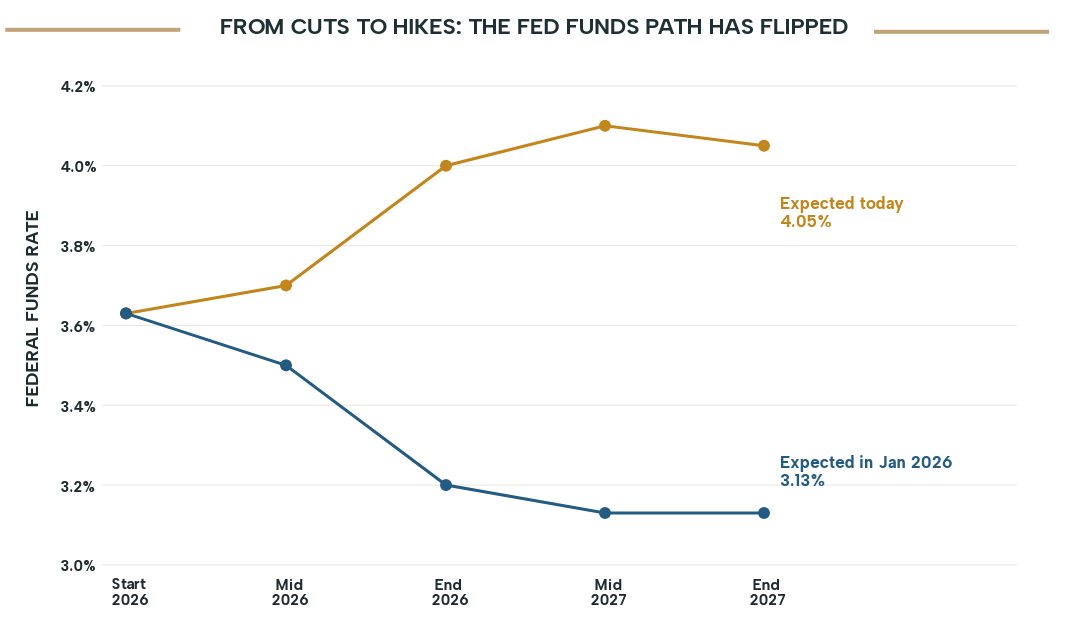
When 2026 began, the market had clear expectations: the Federal Reserve would be cutting rates this year. The March dot plot still penciled in 25 basis point reductions for both 2026 and 2027, and fed funds futures were priced accordingly. Six months later, that story has reversed.
At its June meeting, the Fed left the target range unchanged at 3.50% to 3.75%, but the bigger news was in the projections. The committee’s own median forecast shifted toward a hike, and 17 of 18 officials now see inflation risk tilted to the upside. Markets moved quickly to follow. Fed funds futures now imply roughly a 77% probability of a rate increase by December, up from about 24% a month earlier.
What Is Driving Inflation
Just as important as the direction of rates is the changing character of inflation itself. The story is evolving away from commodity shock inflation, the energy and supply driven pressures that dominated recent quarters, and toward what we would call investment cycle inflation.
A historic wave of capital spending is now feeding through to prices. AI infrastructure, surging power demand, data center construction, semiconductors, and the financing activity that funds all of it are becoming core inflation drivers in their own right. This kind of inflation is more structural and less likely to fade on its own than a one off move in oil, which helps explain why the Fed has grown more cautious about declaring victory.
Policy Implication
Markets remain uncomfortable with the hawkish tone of the new Fed regime, but aggressive tightening still looks unlikely. The Warsh Fed appears to be:
- Structurally restrictive, keeping policy tight to hold the line on inflation.
- Selectively data dependent, reacting to the inflation signals that matter most.
- Focused on credibility rather than actively trying to slow growth.
In other words, the goal looks more like anchoring expectations than engineering a slowdown. That is a meaningful distinction for how far rates ultimately move.
Why This Matters for Your Portfolio
The repricing has been sharpest at the front end of the bond market, where the 2 year Treasury yield jumped to around 4.15%. A few themes stand out:
- Rates may stay higher for longer, especially in shorter maturities.
- Cash and short duration bonds continue to offer meaningful yield.
- Diversification matters more when the policy path is uncertain.
With the inflation backdrop shifting and the policy path far from settled, we continue to favor active management in fixed income portfolios. A selective, research driven approach lets us manage duration deliberately and pursue opportunities across sectors and maturities as conditions evolve, rather than relying on a single rate forecast.
Bottom Line
The swing from expected cuts to potential hikes is a reminder that rate forecasts are not promises. We are positioning portfolios for a range of outcomes rather than a single bet, staying disciplined as the new Fed finds its footing.
Source: FOMC June 17, 2026 meeting and Summary of Economic Projections; CME fed funds futures. Chart is illustrative; January path reflects one to two expected cuts toward the 3.00% to 3.25% range, and today’s path reflects futures as of June 17, 2026.
Filed under
Third Party Site
The information being provided is strictly as a courtesy. When you link to any of the websites provided here, you are leaving this website. We make no representation as to the completeness or accuracy of information provided at these websites. Nor is the company liable for any direct or indirect technical or system issues or any consequences arising out of your access to or your use of third-party technologies, websites, information and programs made available through this website. When you access one of these websites, you are leaving our web site and assume total responsibility and risk for your use of the websites you are linking to.
Dated Material
Dated material presented here is available for historical and archival purposes only and does not represent the current market environment. Dated material should not be used to make investment decisions or be construed directly or indirectly, as an offer to buy or sell any securities mentioned. Past performance cannot guarantee future results.
