



Family Wealth
The Brew: Trump Accounts – What You Need to Know

May 21 2026
By now, many of you have heard about Trump Accounts (also referred to as 530A Accounts), introduced in the “One Big Beautiful Bill Act,” and set for roll out July 4, 2026. These accounts are designed to encourage long-term investing for children by starting early and compounding over decades.
Like UGMA/UTMA accounts, a parent or guardian manages the Trump Account until the beneficiary child turns 18. At that point, the account converts to a Traditional IRA allowing the beneficiary to take total control, potentially creating planning opportunities. As written today, a potential drawback to the account is individual contributions to Trump Accounts do not appear to qualify as “present interest gifts” and gifting to the account likely requires filing gift tax returns in the year contributions are made.
Key Features
Contribution Limits & Eligibility
- Annual contribution limit of $5,000 per child (combined across family, friends, and employers)
- Employer contributions up to $2,500 count toward the annual limit but are excluded from the child’s taxable income
- Contributions from qualified charities and government entities do not count toward the $5,000 cap
- Children under age 18 with a Social Security Number are eligible
- Children born between 2025 and 2028 receive a $1,000 initial government contribution
Investment Parameters
- Limited to low-cost U.S. equity index funds (e.g., S&P 500 ETFs) with expense ratios of 0.10% or less
- No built-in option to shift to more conservative investments over time
- No withdrawals permitted before age 18
Potential Planning Opportunity at Age 18
Before age 18, the focus of Trump accounts is investment growth. Once the account beneficiary attains age 18, the account converts to a Traditional IRA, and there may be an opportunity for additional planning.
Under current rules, a potential planning strategy is to consider full or partial Roth conversions when the account turns into a Traditional IRA. The thought being at age 18, most account beneficiaries will be in the lowest tax brackets of their lives; making the years around the account switching to a Traditional IRA the most opportune time for an account beneficiary to convert the funds. If current laws remain intact, an 18-year-old that converts an amount lower than the then standard deduction ($16,100 in 2026) may owe no income tax at the time of conversion.
While ordinary income taxes may be due on the conversion, future growth in Roth IRAs are income tax-advantaged during the beneficiaries’ lifetime. Assuming the Roth IRA rules don’t change, allowing for multiple decades of compounding, income tax-advantaged growth could turn the account into a significant, tax-advantaged nest egg. (See our March 2026 Insight that illustrated a $49,500 Roth account at age 18 growing at 6% for decades).
Tax Considerations
Are Trump Account Contributions Tax-Deductible?
No. Individual contributions are made with after-tax dollars. Separately, employer contributions are not taxable to the child.
How Are Distributions Taxed?
- Contributions are not taxed again when withdrawn.
- Earnings, employer contributions, and government contributions are taxed as ordinary income
- After the IRA transition, withdrawals before age 59½ may be subject to a 10% penalty unless an exception applies
Important
*Do contributions CURRENTLY qualify for the annual gift tax exclusion?
As of today, IRS guidance here is limited. Early interpretations suggest contributions to Trump accounts do not qualify as “present interest gifts,” meaning gifting to these accounts would use lifetime exemption and require gift tax reporting. This could change before year end, so stay tuned if you choose to make contributions before further guidance is issued by the Treasury.
Coordinating with Roth IRAs
Trump Accounts do not replace Roth IRAs. Once a child has earned income, a custodial Roth IRA can also be funded with the lesser of the child’s earned income or the annual contribution limit. In 2026, the annual limit is $7,500. Both strategies can be used together to enhance long-term, tax-efficient savings.
These accounts do not replace Roth IRAs. Once a child has earned income, a custodial Roth IRA can also be funded (up to the lesser of earned income or $7,500 annually). Both strategies can be used together to enhance long-term tax-efficient savings. For additional guidance, see our article on funding custodial Roth IRAs: Pay Your Kids (Legally) and Jumpstart Their Retirement with a Roth IRA.
Multiple Goals; Multiple Accounts?
An additional consideration is to fund multiple child savings accounts for different goals. For example: Fund 529s for education-related goals, UTMAs/UGMAs, and direct gifts for early lifetime goals, and Roth IRAs and/or Trump accounts for long-term goals.
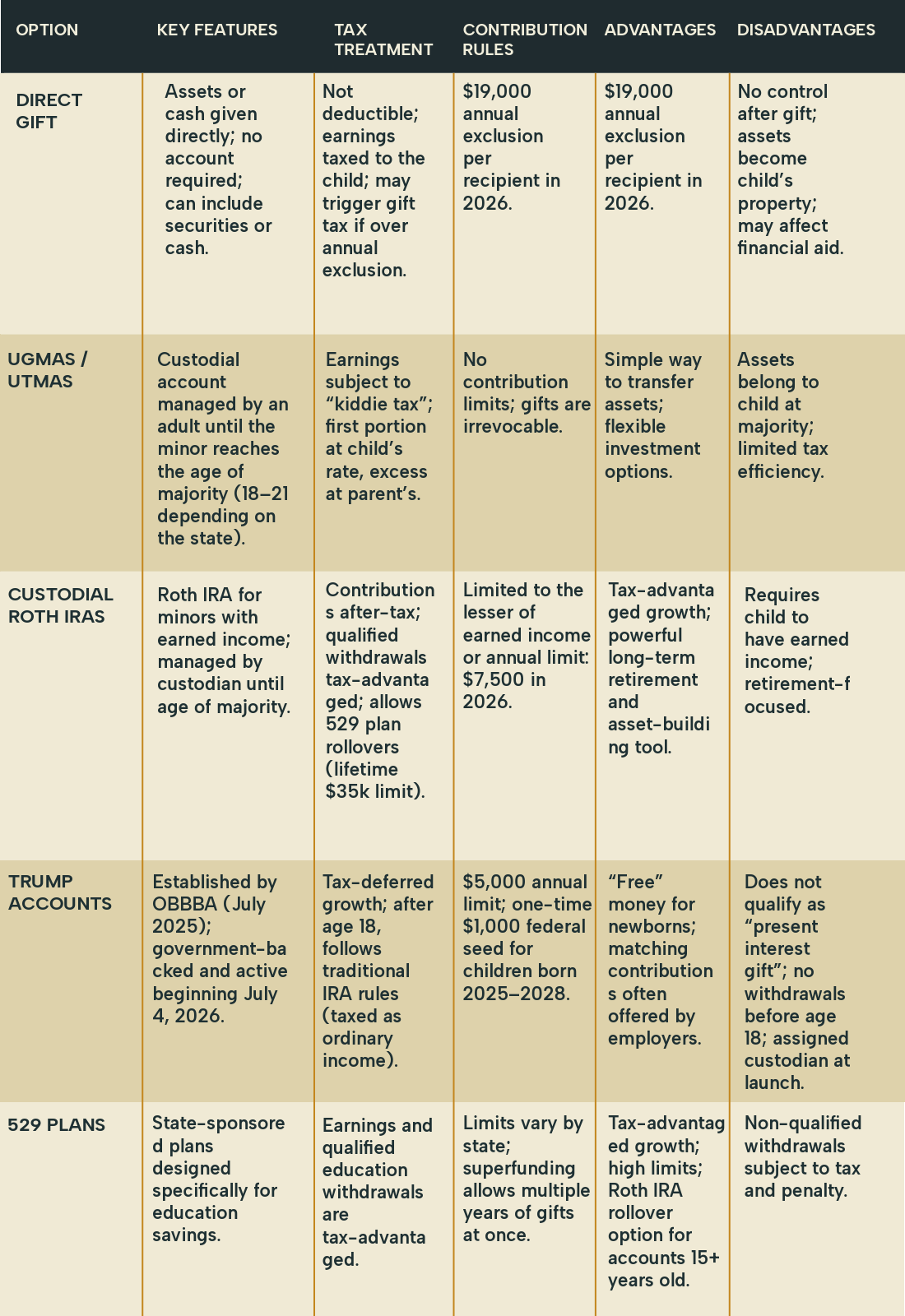
Below find a comparison chart of the different features of each account type:
As always, consider speaking to your advisors before taking action!
References:
taxesforexpats.com – Trump Account Age 18 Withdrawal Rules
trumpaccounts.gov – Official Trump Accounts Website
https://www.schwab.com/learn/story/trump-accounts
AICPA Podcast – Trump Accounts are Coming – and You Need to be Ready
ACTEC Podcast – Trump Accounts (IRC §530A): Estate, Tax, and Wealth Planning Considerations
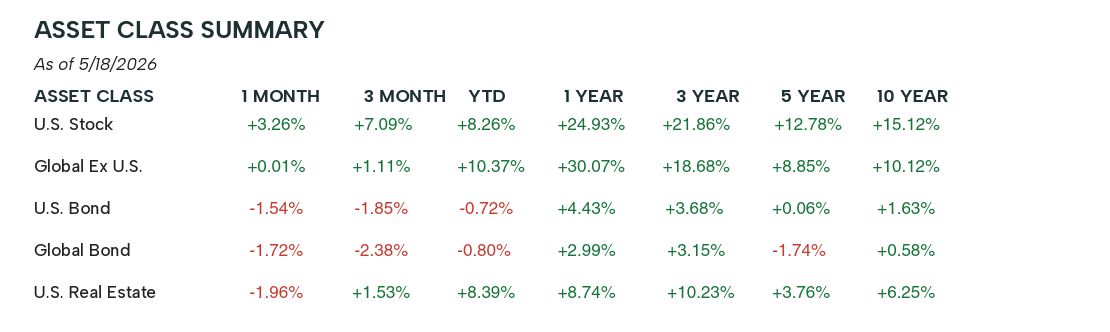
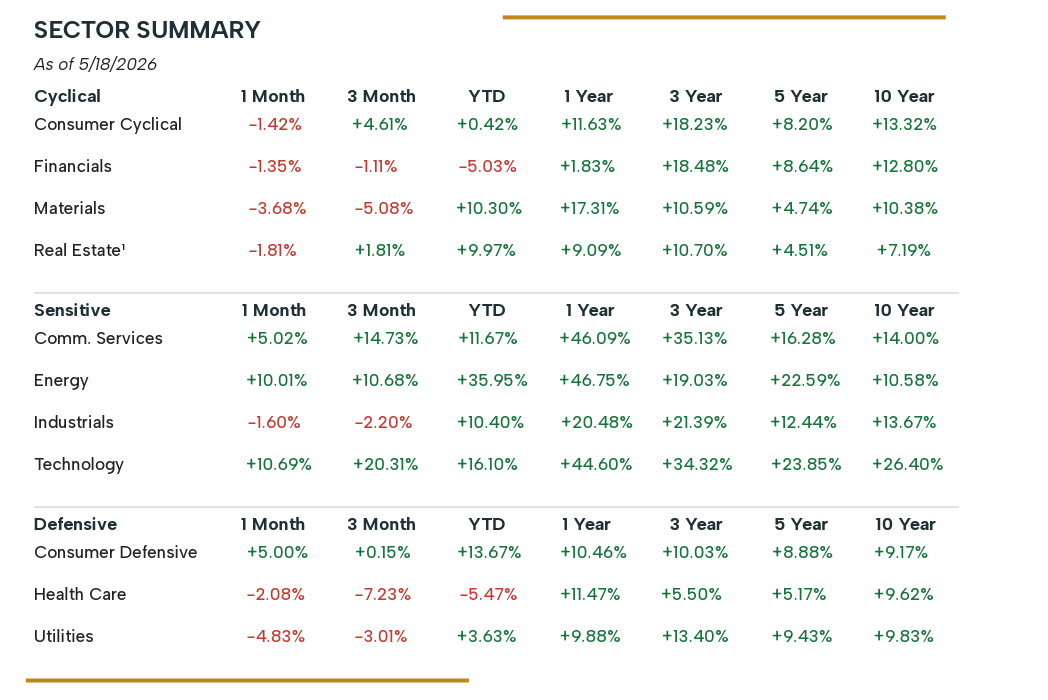
MARKET BACKDROP
Filed under
Third Party Site
The information being provided is strictly as a courtesy. When you link to any of the websites provided here, you are leaving this website. We make no representation as to the completeness or accuracy of information provided at these websites. Nor is the company liable for any direct or indirect technical or system issues or any consequences arising out of your access to or your use of third-party technologies, websites, information and programs made available through this website. When you access one of these websites, you are leaving our web site and assume total responsibility and risk for your use of the websites you are linking to.
Dated Material
Dated material presented here is available for historical and archival purposes only and does not represent the current market environment. Dated material should not be used to make investment decisions or be construed directly or indirectly, as an offer to buy or sell any securities mentioned. Past performance cannot guarantee future results.
