



Market Outlooks
Beyond the Bell: Fixed Income – Better Days Ahead

Beyond the Bell: Fixed Income – Better Days Ahead
After a challenging decade for bonds, the fixed income environment looks considerably different today. Higher starting yields have restored a more meaningful income component and may offer a more attractive outlook for investors.
Sign Up for Beyond the BellSeptember 25 2026
“No matter how dark the night, somehow the sun rises once again and all shadows flee.” — Vern McLellan
Bond investors have weathered a long proverbial storm of poor returns. Over the past ten years, bonds, as represented by the Bloomberg U.S. Aggregate Bond Index (the “Agg”), have averaged a 1.3% annual total return. Over the past five years alone, the Agg has declined nearly 3%. Given that fixed income has traditionally been a relatively stable contributor to portfolio performance, this extended period of disappointing returns has prompted several questions: What happened? Why own bonds? And what do we expect going forward?
What happened?
Over the past several years, we have transitioned from a historically low interest-rate environment to a more normalized one. For context, the U.S. 10-year Treasury yield was approximately 1.7% ten years ago and fell as low as 0.5% in 2020. Today, it is near 5%. As interest rates rose, the prices of existing bonds declined, weighing on bond portfolio total returns.
Why own bonds?
There are several reasons. First, fixed income can serve as an effective portfolio diversifier, helping to mitigate some of the volatility associated with equities. Second, bonds can provide a relatively steady stream of income that equities may not consistently provide.
Ultimately, we believe a portfolio’s fixed income allocation should be aligned with the investor’s risk tolerance, liquidity needs, time horizon, and overall financial objectives.
What do we expect going forward?
Perhaps the most important point is that bond investors are starting from a much higher yield environment today than they were five, ten, or fifteen years ago. As the chart below illustrates, 10-year forward returns for bond portfolios, as represented by the Agg, have historically been strongly correlated with starting yields. With yields near 5%, the outlook for future bond returns is meaningfully more attractive than it was when yields were near historic lows.
After a challenging decade, the setup for bonds looks considerably different than it did just a few years ago. Higher starting yields have restored a more meaningful income component to fixed income and, in our view, make the asset class an important consideration for well-diversified portfolios.
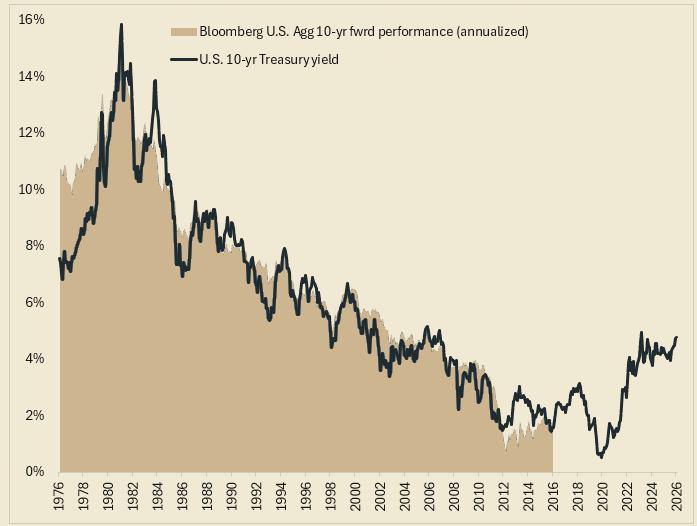
Sources: Bloomberg and SEIA. Monthly data: September 30, 1976 – August 31, 2026.
Enjoying Beyond the Bell?
Stay connected with SEIA for the latest market insights, perspectives, and updates.
You can also follow SEIA on LinkedIn and Facebook for additional insights and firm updates.
Signature Estate & Investment Advisors, LLC (SEIA) is an SEC-registered investment adviser; however, such registration does not imply a certain level of skill or training and no inference to the contrary should be made. Securities offered through Signature Estate Securities, LLC, member FINRA/SIPC. Investment advisory services offered through SEIA, 2121 Avenue of the Stars, Suite 1600, Los Angeles, CA 90067, (310) 712‑2323. This material is provided for informational purposes only and does not constitute individualized investment advice or a recommendation of any specific security, strategy, or course of action. Fixed income investments are subject to various risks including changes in interest rates, credit quality, inflation risk, market valuations, prepayments, corporate events, tax ramifications and other factors. Different types of investments involve varying degrees of risk, and there can be no assurance that any specific investment will be profitable or suitable for a particular investor’s financial situation or risk tolerance.
Third Party Site
The information being provided is strictly as a courtesy. When you link to any of the websites provided here, you are leaving this website. We make no representation as to the completeness or accuracy of information provided at these websites. Nor is the company liable for any direct or indirect technical or system issues or any consequences arising out of your access to or your use of third-party technologies, websites, information and programs made available through this website. When you access one of these websites, you are leaving our web site and assume total responsibility and risk for your use of the websites you are linking to.
Dated Material
Dated material presented here is available for historical and archival purposes only and does not represent the current market environment. Dated material should not be used to make investment decisions or be construed directly or indirectly, as an offer to buy or sell any securities mentioned. Past performance cannot guarantee future results.