



Tax Planning
Pay Your Kids (Legally) and Jumpstart Their Retirement with a Roth IRA

Parents may be able to help their children begin building long-term wealth early by contributing earned income to a Roth IRA.
March 26 2026
Recently, a client mentioned they’ve been seeing TikTok videos regarding the benefits of owning a business and paying children. The client asked if this was real and how they should think about it. In fact, this is real. And when done properly, paying children from a family business has many features, including: allowing business owner parents to help reduce taxable income, teaching children valuable work habits, and giving children a head start on retirement savings through a powerful tax-advantaged retirement savings tool, a Roth IRA.
And for anyone that had income in 2025, regardless of whether that income came from a family business, contributions to Roth IRAs are allowed until April 15th 2026!
The Basics
Permitted / Acceptable
- For sole proprietorships and parent-only partnerships, the IRS allows parents to put their children on payroll and receive payroll tax exemptions.
- The work must be real, such as filing papers, cleaning office space, creating basic social media posts, or helping with inventory.
- Compensation should reflect the fair-market value of the work performed.
- Keep meticulous records, including job descriptions, timesheets, and W‑2s.
Not Permitted / Not Acceptable
- Corporations and LLCs can put children on payroll, but they do not receive the same payroll tax exemptions.
- Basic household chores… NOT ok.
- Paying your children more than you’d pay others to do the same work or not keeping records → Your child’s salary could be reclassified as a gift, tax breaks gone.
Tax Features for Business and Families
- Business Deduction: Wages paid to children can be deductible as a business expense.
- Payroll Tax Relief: Wages paid to children under 18 are exempt from Social Security and Medicare taxes. And if the child is under 21, the business doesn’t have to pay federal unemployment tax on the wages either (FUTA) (1).
- Income Tax for the Child: In 2026, the standard deduction is $16,100. If a child earns less than that, they likely owe no federal income tax.
Funding a Roth IRA
Once a child has legitimate earned income (whether from a family business, or otherwise), they’re eligible to contribute to a Roth IRA, even if the parents are the one providing the funds for the contribution (this can be a part of the annual gift exemption). For 2025, the maximum contribution is the lesser of earned income or $7,000. This amount goes up by $500 in 2026 (2026 Roth contributions can be made until April 15, 2027).
Opening and funding a custodial Roth IRA (instead of a regular Roth IRA) allows parents to manage the account until the child reaches the age of majority (18 or 21, depending on state law). It is important to remember that at that point, the funds legally become the child’s property with no restrictions on their use. Contributions are made with after-tax dollars, but qualified withdrawals in retirement are completely tax-free.
Case Study: Skincare Startup Mom (Sarah) and her daughter employee (Mia)
The case study presented is hypothetical and for illustrative purposes only. It does not represent actual trading or client results. Individual tax situations vary. Tax outcomes and investment results will vary based on individual circumstances and market conditions.
Sarah runs GlowLab, her skincare brand as a sole proprietor. Her 12-year-old Mia pitches in with real work: Instagram product shots (10 hours a week at $15/hour, totaling $7,500 yearly), packing samples, spreadsheet updates for stock.
Sarah deducts every penny. Zero FICA or FUTA. In addition to Mia’s W‑2 income, having earned income of $7,500 allows Mia to make the full Roth contribution. In this case, Sarah uses part of her $19,000 annual exclusion to gift $7,000 to Mia’s custodial Roth IRA. Result: In this example, Sarah could reduce her taxable income, which may result in tax savings depending on her tax bracket. Mia’s retirement fund starts compounding early. By 60, it’s transformative. Let’s look at the potential impact:
Compounding (6% Return)
Sarah funds Mia’s Roth with $7,500 yearly from ages 12 to 18 ($49,500 total). Let’s assume Mia gets an average annual return of 6%…
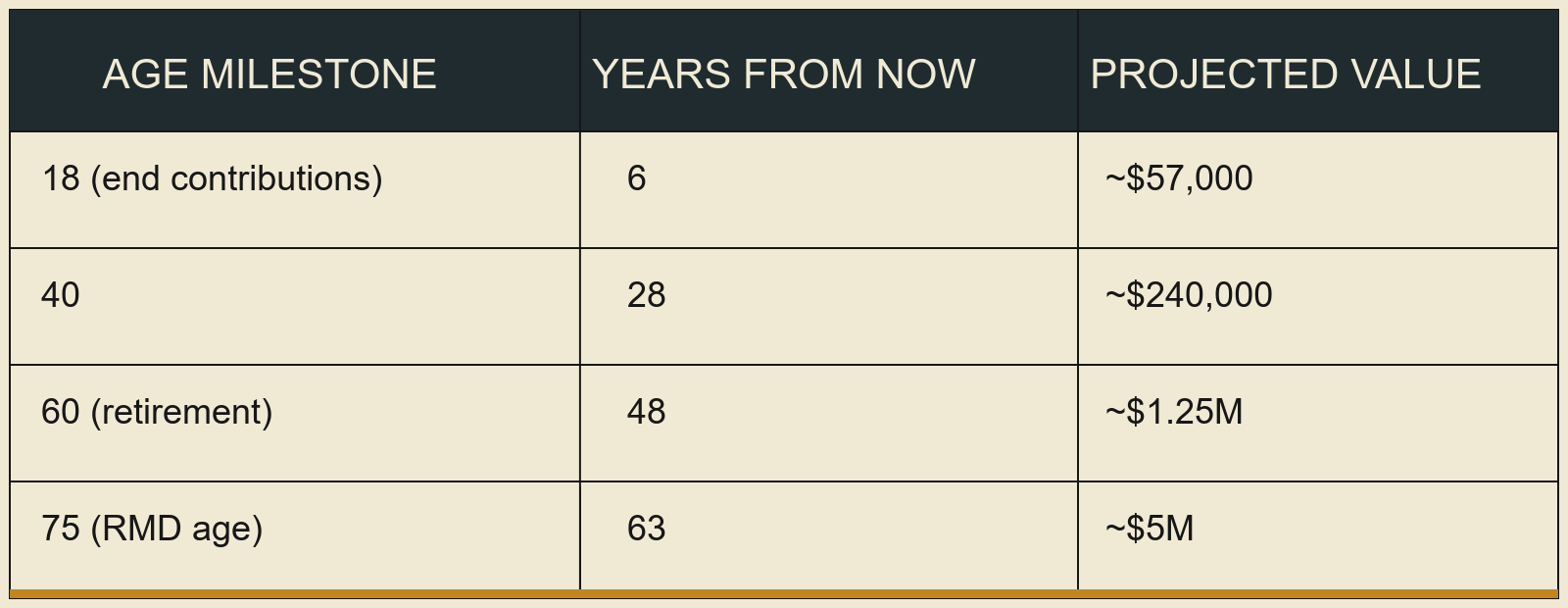
These figures are hypothetical and is an illustrative example using 6% hypothetical average annual return compounded annually. Actual returns will vary and are not guaranteed. This example is for informational purposes only and is not a prediction of future growth.
This illustrates the incredible power of compounding and tax-free growth. As long as the child has earned income, parents can gift funds to help them continue contributing throughout their working years, creating a multigenerational wealth strategy. Imagine how the account could grow if Mia contributes to her Roth IRA past age 18!
Final Thoughts
Paying your children for legitimate work and funding a Roth IRA is a planning strategy that can provide tax and long-term savings benefits for some families. It can reduce the business’s taxable income, gives children potentially decades of tax-advantaged growth, and instills financial responsibility. When done correctly, it can create a long-term impact for your business and family.
Important Information
Sources
- IRS – Family Employees: https://www.irs.gov/businesses/small-businesses-self-employed/family-employees
- IRS – Standard Deduction Amounts for 2026: https://www.irs.gov/newsroom/irs-releases-tax-inflation-adjustments-for-tax-year-2026-including-amendments-from-the-one-big-beautiful-bill
- IRS – IRA Contribution Limits: https://www.irs.gov/newsroom/401k-limit-increases-to-24500-for-2026-ira-limit-increases-to-7500
- Fidelity – Turbocharge Your Child’s Retirement: https://www.fidelity.com/learning-center/personal-finance/retirement/turbocharge-childs-retirement
- TurboTax – Benefits of Employing Your Children: https://blog.turbotax.intuit.com/business/the-benefits-of-employing-your-children-and-the-tax-breaks-involved-65022/
- TaxSlayer – Hiring Your Child: Small Business & Self-Employed Taxes: https://www.taxslayer.com/blog/hiring-your-child-small-business-self-employed-taxes/
Signature Estate & Investment Advisors, LLC (SEIA), an SEC-registered investment adviser, notes that such registration does not imply specific skill or training; no contrary inference should be drawn. This material is provided for informational and educational purposes only and is not intended as individualized investment, tax, legal, estate planning, or accounting advice, nor as a recommendation of any spec Investors should consult with their financial advisor before making any investment decisions. Effective strategy, product, or course of action. Tax laws, regulations, and interpretations are complex and subject to change, and the information summarized herein may not reflect subsequent legislative or regulatory developments. The application of tax rules can vary significantly based on individual circumstances. Investors should consult with qualified tax, legal, or financial professionals regarding their specific situation before taking any action. Investment decisions should be based on a client’s individual financial needs, objectives, goals, time horizon, and risk tolerance. All investments involve risk, including the possible loss of principal.
Filed under
Third Party Site
The information being provided is strictly as a courtesy. When you link to any of the websites provided here, you are leaving this website. We make no representation as to the completeness or accuracy of information provided at these websites. Nor is the company liable for any direct or indirect technical or system issues or any consequences arising out of your access to or your use of third-party technologies, websites, information and programs made available through this website. When you access one of these websites, you are leaving our web site and assume total responsibility and risk for your use of the websites you are linking to.
Dated Material
Dated material presented here is available for historical and archival purposes only and does not represent the current market environment. Dated material should not be used to make investment decisions or be construed directly or indirectly, as an offer to buy or sell any securities mentioned. Past performance cannot guarantee future results.